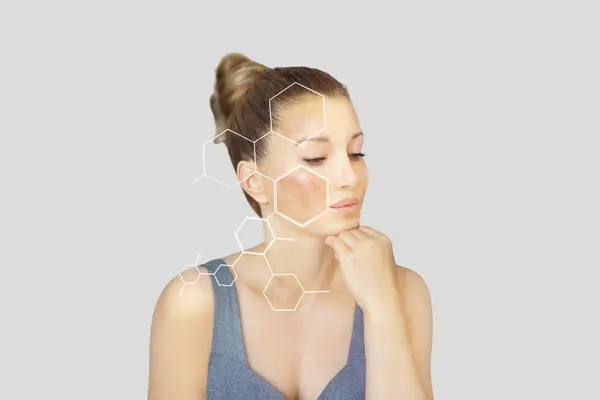
Ruby spots
Small red skin dots you should know about
What are ruby spots?
Ruby spots are tiny, bright red skin changes that many people encounter during their lifetime. Medically they are called hemangiomas; in everyday language they are often referred to as cherry angiomas, a name that reflects their intense cherry‑red colour. They range in size from a small pinhead to a pea and arise from benign vascular overgrowths just under the skin.
They appear particularly frequently on the trunk, but can also occur elsewhere. At first they are flat and well defined; over time they can become slightly raised and nodular. They are among the most common and noticeable, yet harmless, skin findings.
How do ruby spots form?
Ruby spots develop when the smallest blood vessels directly under the skin change. The vessel walls thicken and sharply defined, bright red dots or small nodules become visible on the surface. They occur most often on the torso—chest, abdomen and back—but can also be seen on the arms, legs or even the face.
The exact reason these vascular changes occur is not yet fully understood. What is clear is that multiple factors play a role. The likelihood of developing ruby spots increases with age. Genetic predisposition also appears to be important. Studies have also shown that people with elevated blood lipid levels are more frequently affected. Even during pregnancy, hormonal changes can lead to the appearance of these small red skin dots.
Wie würden Sie reagieren, wenn Sie plötzlich ein neues rotes Hautmal entdecken?
What symptoms do hemangiomas show?
Hemangiomas are generally clearly visible but do not cause discomfort. Characteristic is a bright red to purple‑bluish discoloration of the skin that is either flat within the surface or visible as a small raised bump. Their appearance varies with skin type: on light skin they appear redder, on darker skin more violet.
In principle hemangiomas do not itch or hurt. They can, however, become noticeable if injured. This can lead to bleeding, and the resulting wound often heals slowly. Their location can be particularly problematic if they form near sensitive areas such as the eyes, as they may then impair vision.
editorial.facts
- About 4–5% of all newborns are born with a hemangioma – most commonly on the head or neck. In most cases these so‑called “strawberry hemangiomas” disappear on their own by the age of five, without the need for treatment.
- There is a rarer form, the so‑called cavernous hemangioma, which can even occur in organs or in the central nervous system. Because it consists of larger, highly vascularised vessels, it carries a risk of blood clots (thrombi) – spontaneous regression has not been observed in these cases.
Are ruby spots dangerous?
Ruby spots are completely harmless. They do not cause itching or pain and generally present no health risk. They can, however, sometimes draw attention—for example if they bleed due to friction or a small injury. Small blood clots can also form within the dilated vessel loops, temporarily darkening the spot.
Although benign, it is sensible to keep an eye on changes. If a ruby spot suddenly changes shape, colour or size or looks unusual, a visit to your GP or dermatologist is recommended. During a skin examination the clinician can quickly determine whether it is indeed a cherry angioma or if another cause is at play.
Who is affected by these small red dots?
They can appear on any skin type. They are, however, somewhat more common in people with light skin and are therefore more noticeable there. Men and women are affected equally, so this is a phenomenon that occurs across the population.
Predisposition also plays an important role. Those who are genetically inclined often notice the bright red spots earlier or in larger numbers. With increasing age the likelihood rises further, so the spots become a normal companion for many people.
Do ruby spots go away on their own?
Once they have developed, they do not disappear spontaneously but usually remain permanently. Although harmless to health, many people find the small red dots cosmetically bothersome.
If the skin changes trouble you, you can have them removed if you wish. Various cosmetic procedures are available, though they always carry some risk—for example of scarring. In most cases ruby spots remain a natural feature of life and are no reason for concern.
How can ruby spots be removed?
Those who are bothered by ruby spots have several options to get rid of the small red dots. A particularly widespread method is laser treatment. Concentrated light is directed into the skin, heating and sealing off the affected vessels. The body then gradually resorbs the tissue. Usually a short session of 5 to 15 minutes is sufficient. After treatment the skin may be slightly red or swollen, but this typically resolves quickly.
Another option is electrocoagulation. The affected areas are treated with high‑frequency current, which selectively coagulates the vessels. This procedure also takes only a few minutes and the skin heals on its own within a few days. In both cases it is important to protect the treated skin from UV exposure, ideally with a high sun protection factor.
Home remedies such as apple cider vinegar, honey or castor oil do not help, as their effectiveness is not scientifically proven. If you prefer to avoid procedures, you can at least visually conceal ruby spots. Concealer, foundation or tinted creams make the red dots considerably less noticeable in everyday life.
Ruby spots: how to deal with them safely and properly
- Observe changes closely. In most cases ruby spots are harmless. Still, stay vigilant. If a spot changes in size, shape or colour, a visit to a dermatologist is advisable to ensure no other skin condition is the cause.
- Have a professional make the diagnosis. Often the experienced eye of a dermatologist is enough to recognise a cherry angioma. With specialised tools such as a dermatoscope clinicians can assess the vascular structure more precisely. This helps rule out malignant changes.
- Never remove ruby spots yourself. As harmless as these small red dots may appear, picking or cutting them can lead to infection, heavy bleeding or unattractive scarring. Leave removal to medical professionals.
- Opt for laser therapy for smooth results. Modern laser treatment is considered particularly gentle. It targets and seals off the affected vessels, which are then removed by the body. Usually a short session is enough and the skin looks inconspicuous again within a few days.
- Protect the skin after procedures. Whether laser or electrocoagulation, sun protection is mandatory after treatment. Be sure to use creams with a high SPF and avoid direct sun exposure to allow optimal healing.
- Avoid questionable home remedies. Recipes using apple cider vinegar, honey or castor oil promise much but do not work. There is no scientific evidence—on the contrary, these applications can irritate the skin. Trust proven medical procedures instead.
- Use make‑up as a gentle solution. If you do not wish to have your ruby spots removed, you can cover them skilfully. Concealer, foundation or tinted day creams reliably camouflage the red dots—particularly useful on visible areas like the décolletage or arms.
- Note any family clustering. Genetics plays a role: if many ruby spots occur in your family, the likelihood that you will have them increases. In such cases regular skin checks are especially sensible.
- Take blood values seriously. Studies indicate that elevated blood lipid levels may promote the development of ruby spots. A healthy lifestyle with a balanced diet and physical activity therefore also helps prevent skin changes.
- Plan procedures for the right season. Laser or cold treatments are best carried out during months with less sun. This avoids UV exposure during healing and protects treated skin.
- Consider potential scarring. Every removal method can leave small scars. Think carefully about whether the spots truly bother you. Sometimes acceptance is the healthiest decision.
Ruby spots are among the most common yet harmless skin changes that many people develop over their lifetimes. They have no medical consequence but can be perceived as an aesthetic nuisance. Whether you choose removal or accept them as a natural companion, the important thing is to be informed and to watch for any changes.